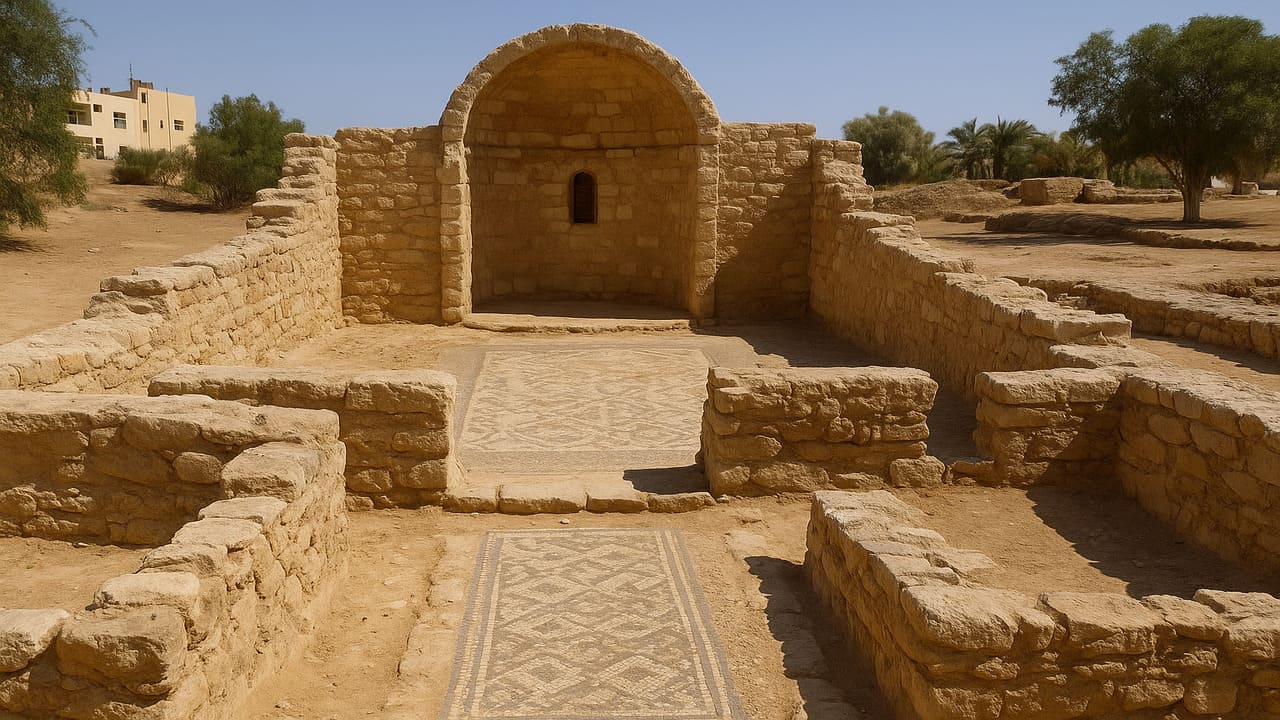
Thorn Ville Church – In the windswept desert city of Aqaba, Jordan, nestled between the dramatic red mountains of Wadi Rum and the turquoise waters of the Red Sea, lies one of the most important yet lesser-known Christian landmarks in the world Aqaba Church. While many associate early Christianity with the grand basilicas of Rome or the catacombs beneath ancient cities, archaeological evidence points to Aqaba as the site of the oldest known purpose-built Christian church, dating as far back as the late 3rd or early 4th century AD.
This ancient structure challenges assumptions about the geographical and cultural boundaries of early Christianity and sheds light on the religion’s architectural evolution in the Roman Near East. Far from the imperial centers of Christianity’s later rise, Aqaba tells a story of early believers constructing sacred spaces amid trade routes and tribal crossroads.
The Aqaba Church remained largely forgotten until excavations conducted in the early 1990s by archaeologists working under the direction of the Department of Antiquities of Jordan. Located just a short distance from the modern city center, the site revealed the foundation of a rectangular building with a clear basilica layout complete with a nave, side aisles, and an apse.
What distinguishes the Aqaba Church from earlier Christian sites is its intentional religious architecture. Unlike house churches or Roman villas repurpose for worship, this building was design specifically for Christian liturgical use, likely by a community that had recently gained the freedom to practice their faith openly following the Edict of Toleration by Emperor Galerius in AD 311, and later, the Edict of Milan in AD 313.
Also Read : The Monastery of Saint Anthony: A Desert Fortress of Faith in Egypt
Despite its modest dimensions, the Aqaba Church bears architectural hallmarks that would define church design for centuries. Its orientation toward the east, the presence of a central nave flanked by aisles, and the elevated apse where clergy would have presided over the Eucharist all point to a community invested in sacred structure and symbolism.
Traces of mosaic floors and reused Roman stones suggest a blend of styles and resources, common in frontier regions of the Roman Empire. There’s even evidence that the building underwent modifications likely expansions before being damage in a 7th-century earthquake, a reminder of the fragility and resilience of early Christian life in the region.
Aqaba’s strategic location on the Red Sea connected it to major trade routes between Arabia, Egypt, and the Levant. This made it a melting pot of ideas, languages, and faiths. The existence of a church so early in this multicultural environment suggests that Christianity had not only arrived but had taken root in communities far from imperial centers.
This also reveals an era of coexistence and transformation. Christianity in Aqaba emerged during a time when the Roman Empire was moving from persecution to toleration, and eventually to imperial endorsement of the faith. The presence of such a church serves as physical evidence of Christianity’s shifting role from marginalized sect to a structured, organized religion with communal spaces.
Read More : Global Setback: Major Economies Stall on Tripling Renewable
The significance of the Aqaba Church becomes even more profound when placed in comparison with other early Christian structures. For example, the Church of the Holy Sepulchre in Jerusalem and the Church of the Nativity in Bethlehem, both construct in the early 4th century under Emperor Constantine, were built after Aqaba’s church.
Unlike those grand imperial-sponsored churches, Aqaba represents grassroots Christianity built not with imperial decree, but with local labor and faith. This makes it a valuable case study for historians and archaeologists seeking to understand how Christianity adapted and developed in frontier zones, before the religion’s consolidation into Roman statehood.
Modern parallels can also be draw from the way the church was construct with limited resources, reused materials, and a deep sense of purpose. These same values are echo in many churches built today in developing regions, reminding us that the spirit of early Christianity continues in different cultural and geographic settings.
Thornville Church - Your Source for Biblical Inspiration – Recent discoveries in biblical archaeology church narratives have shed new light…
Thornville Church - Your Source for Biblical Inspiration - A remarkable event unfolded during a night in Philippi prison, where…
Thornville Church - Your Source for Biblical Inspiration - early churches influenced worship practices that have shaped Christian traditions throughout…
Thornville Church - Your Source for Biblical Inspiration - Ancient christian sites inspire faith by serving as profound reminders of…
Thornville Church - Your Source for Biblical Inspiration - numerous hidden christian heritage sites worth discovering remain off the beaten…
Thornville Church - Your Source for Biblical Inspiration - symbols and artifacts found in early church structures reveal much about…