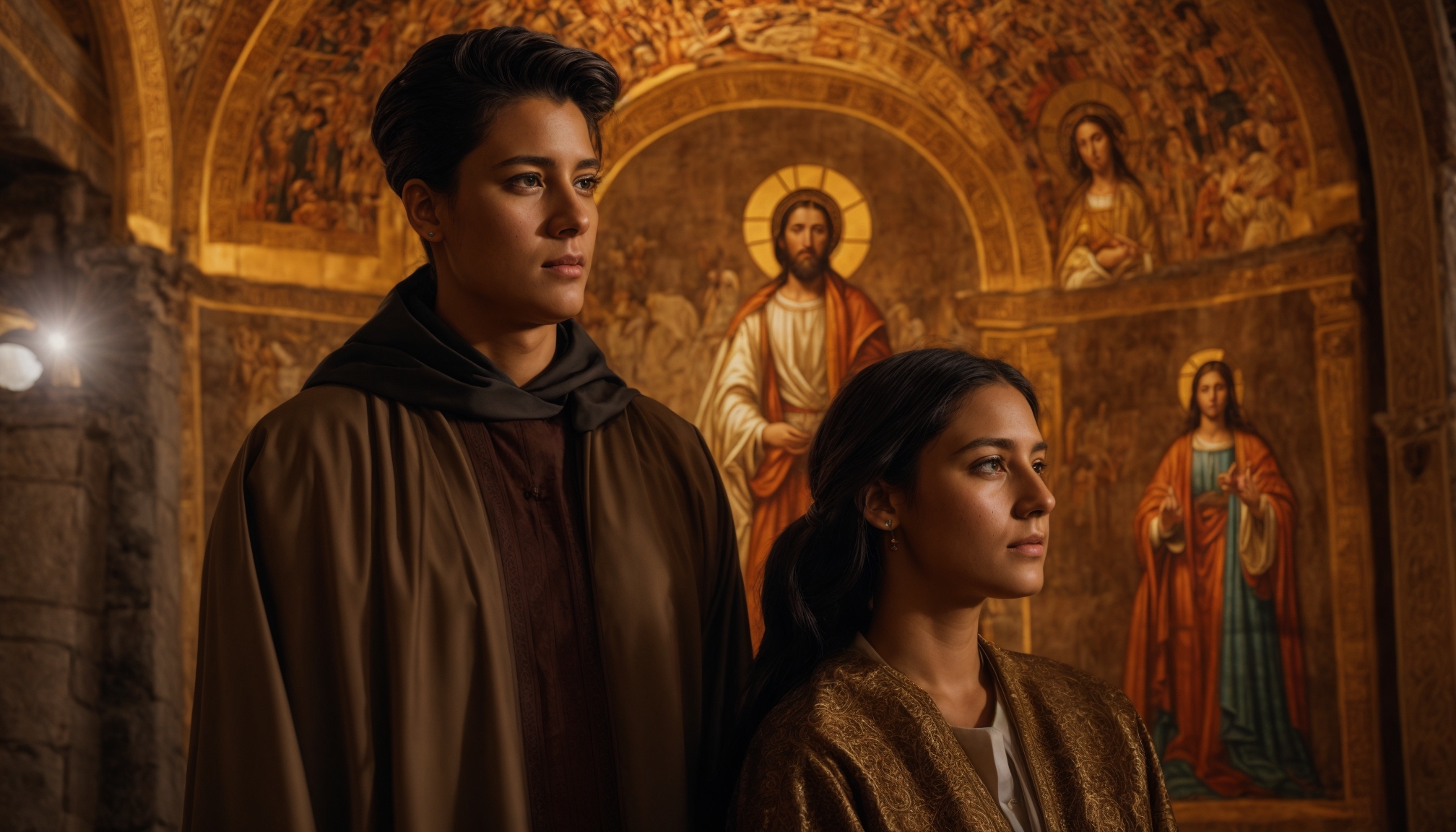
Thornville Church – Your Source for Biblical Inspiration – Sacred art in churches became a visual language that shaped early Christian worship, teaching doctrine through symbols, images, and icons.
From the first centuries of Christianity, sacred art in churches developed as a response to a practical need. Many believers could not read, yet they needed to understand key stories of the Bible. Visual narratives on walls, ceilings, and altars answered this challenge effectively.
Early Christian communities met initially in modest houses and hidden spaces. However, as public churches appeared, sacred art in churches turned these new buildings into visual catechisms. Scenes from the life of Christ, the apostles, and martyrs filled apses and side chapels.
Over time, bishops and patrons realized the power of images to shape devotion. Therefore, they commissioned mosaics, frescoes, and icons to guide prayer and identity. Sacred art in churches did not function as decoration alone, but as theology in color and light.
Sacred art in churches relied on a rich symbolic system. Every color, object, and gesture carried layered meanings. Gold backgrounds suggested divine light and eternity. Blue often symbolized heaven or the Virgin Mary, while red indicated martyrdom, love, or the Holy Spirit.
Animals and everyday objects also had symbolic roles. The lamb signified Christ’s sacrifice. The fish recalled early Christian identity and baptism. On the other hand, the anchor represented hope and steadfast faith in persecution. Through these images, sacred art in churches turned complex doctrines into clear signs.
Gestures were equally important. Raised hands could show blessing or prayer. A book in the hand of a saint marked teaching or the Gospel. Meanwhile, architectural settings, like city walls or temples, placed the scene within salvation history. Nothing in these works was accidental.
The central focus of sacred art in churches was the figure of Christ. He appeared as the Good Shepherd in early catacomb paintings. Later, he was shown as Pantocrator, the Ruler of All, in domes and apses, blessing the faithful with one hand and holding the Gospel in the other.
Mary, the Mother of God, emerged as a key subject, especially after major church councils defined her role in theology. She appeared enthroned with the Christ Child, or standing as an intercessor for humanity. As a result, sacred art in churches helped believers understand her as both mother and advocate.
The saints, particularly martyrs and bishops, were portrayed with recognizable attributes. Saint Peter held keys, while Saint Paul carried a sword or scroll. These visual cues allowed even illiterate worshippers to identify holy figures and remember their stories during prayer.
Over the centuries, regional traditions emerged. In the East, sacred art in churches centered on the icon: a holy image painted on wood, created through strict rules and prayerful preparation. Icons were not simple portraits; they were considered windows into the heavenly realm.
In the West, frescoes and stone carving became more dominant. Church walls became large narrative fields, showing cycles from the Old and New Testaments. Sacred art in churches in Rome, Ravenna, and later medieval Europe turned entire buildings into illustrated Bibles for the faithful.
Despite stylistic differences, both Eastern and Western traditions shared key goals. They aimed to teach doctrine, inspire reverence, and create a sense of sacred presence. Because of that, sacred art in churches continued to evolve while preserving its core spiritual purpose.
The power of sacred art in churches also provoked serious debates. Some groups feared that images could become idols and distract from true worship of God. This fear grew into periods of iconoclasm, especially in the Byzantine Empire, when many icons and mosaics were destroyed.
Defenders of sacred art in churches responded with careful arguments. They claimed that honor given to an image passes to the person represented. Just as a kiss given to a royal seal honors the king, veneration shown before an icon honors Christ or the saint, not wood and paint.
Church councils eventually endorsed this understanding. As a result, the production of icons and murals resumed with new energy. These decisions shaped the look and feel of ancient churches for centuries, preserving the role of images in Christian worship.
Read More: Historical overview of Christian art and symbolic religious imagery
Art historians today study sacred art in churches not only as religious objects, but also as cultural documents. These works reveal how communities understood power, gender, holiness, and daily life. Even minor decorative patterns can reflect trade routes, politics, or local crafts.
Meanwhile, restorers work to preserve fragile frescos, icons, and mosaics. Humidity, war, and neglect have damaged many masterpieces. However, careful conservation helps keep sacred art in churches visible to new generations of pilgrims, scholars, and tourists.
Visitors can still encounter sacred art in churches across the Mediterranean, the Middle East, and Europe. Entering a dim basilica, they see shafts of light touching ancient mosaics. The faces of saints gaze calmly from apses and domes, inviting contemplation.
For modern viewers, sacred art in churches offers more than historical curiosity. It invites slow looking and silent reflection. Even without full knowledge of theology, people can sense the intention behind these works: to connect earth and heaven in a shared space.
Guided tours and scholarly studies add depth, but personal experience matters most. Standing before a worn fresco or a glowing icon, a visitor participates in a long chain of gazes. Centuries of believers once prayed before the same image. Because of that, sacred art in churches still carries a powerful sense of continuity.
Today, contemporary artists and church communities continue to draw inspiration from sacred art in churches. New works echo old compositions, reuse ancient symbols, and adapt traditional iconography to current concerns. The visual language remains flexible, yet rooted in the past.
In museums, fragments of sacred art in churches rest behind glass, studied by experts and admirers. In active sanctuaries, however, these images still function as tools for prayer. They shape how people imagine Christ, Mary, and the saints, and how they understand holiness.
Ultimately, the enduring presence of sacred art in churches shows the human need to see faith made visible. As long as believers gather to worship, symbols, icons, and sacred images will continue to fill their spaces, joining story, beauty, and devotion in a single, luminous tradition.
Thornville Church - Your Source for Biblical Inspiration - A remarkable event unfolded during a night in Philippi prison, where…
Thornville Church - Your Source for Biblical Inspiration - early churches influenced worship practices that have shaped Christian traditions throughout…
Thornville Church - Your Source for Biblical Inspiration - Ancient christian sites inspire faith by serving as profound reminders of…
Thornville Church - Your Source for Biblical Inspiration - numerous hidden christian heritage sites worth discovering remain off the beaten…
Thornville Church - Your Source for Biblical Inspiration - symbols and artifacts found in early church structures reveal much about…
Thornville Church - Your Source for Biblical Inspiration - The story of Daniel in the Lion’s Den remains a powerful…