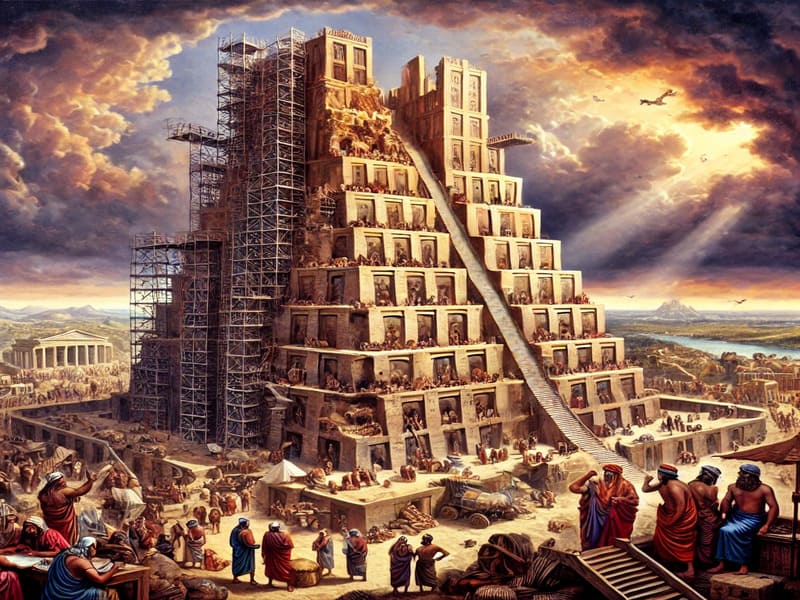
Thorn Ville Church – The story of the Tower of Babel is one of the most intriguing narratives in the Bible, found in the Book of Genesis (Genesis 11:1-9). It describes an ambitious attempt by humanity to build a tower reaching the heavens, an endeavor that was ultimately thwarted by divine intervention. Leading to the confusion of languages and the dispersion of people across the earth.
While the biblical account is rich in theological and cultural significance, it also raises fascinating questions about its historical and archaeological context. Could the Tower of Babel have been a real structure? What does archaeology reveal about the ancient world that might have inspired this story? By examining historical records, ancient Mesopotamian architecture, and linguistic studies, we can explore the possible realities behind this legendary account.
The biblical narrative describes a time when humanity spoke a single language and lived together in unity. The people decided to build a massive tower in the land of Shinar (often associated with ancient Mesopotamia). Using bricks and bitumen to construct a structure that would reach the heavens. However, according to the Bible, God saw their arrogance and ambition as a threat. Confusing their language and scattering them across the earth. This story is often interpreted as an explanation for the origin of linguistic diversity and a reflection on human pride and divine sovereignty.
“Read More: Natural Supplements for Boosting Your Energy and Health”
Although there is no definitive archaeological evidence proving the existence of a singular Tower of Babel, researchers have identified several structures in Mesopotamia that could have inspired the biblical account. The most notable candidates are the ziggurats, massive stepped temples built by the Sumerians, Babylonians, and Assyrians to honor their gods.
The Tower of Babel story is not just about architecture; it also serves as a powerful allegory for the origins of linguistic diversity. Linguistic studies suggest that the ancient Near East was home to multiple language families, including Akkadian, Sumerian, and later Aramaic. The biblical authors, observing the diversity of languages around them, may have sought to explain their origins through this narrative.
Additionally, similar myths of language division exist in other cultures. For example:
These parallels suggest that the story of Babel might reflect a broader ancient understanding of human diversity and divine influence.
The story of the Tower of Babel continues to captivate historians, linguists, and theologians alike. It serves as a reflection on human ambition, cultural identity, and divine authority. Whether based on real historical structures or a theological allegory. The tale remains one of the most enduring and thought-provoking narratives in religious history.
Through ongoing archaeological discoveries and scholarly interpretations. Our understanding of the Tower of Babel and its significance in ancient civilizations continues to evolve. Whether viewed as historical fact or symbolic legend. The narrative provides profound insights into the nature of human unity, division, and the quest for knowledge.
Thornville Church - Your Source for Biblical Inspiration - The miracle of spiritual deliverance appeared in Philippi when Paul freed…
Thornville Church - Your Source for Biblical Inspiration - Historians now highlight how women in early church shaped theology, leadership,…
Thornville Church - Your Source for Biblical Inspiration highlights how church orientation toward east shapes Christian worship, architectural symbolism, and…
Thornville Church - Your Source for Biblical Inspiration reports that recent necropolis discoveries at Colossae are reshaping how scholars read…
Thornville Church - Your Source for Biblical Inspiration highlights how oldest church sites 2025 continue to stand as living testaments…
Thornville Church - Your Source for Biblical Inspiration highlights how ancient churches and sites continue to attract pilgrims, travelers, and…