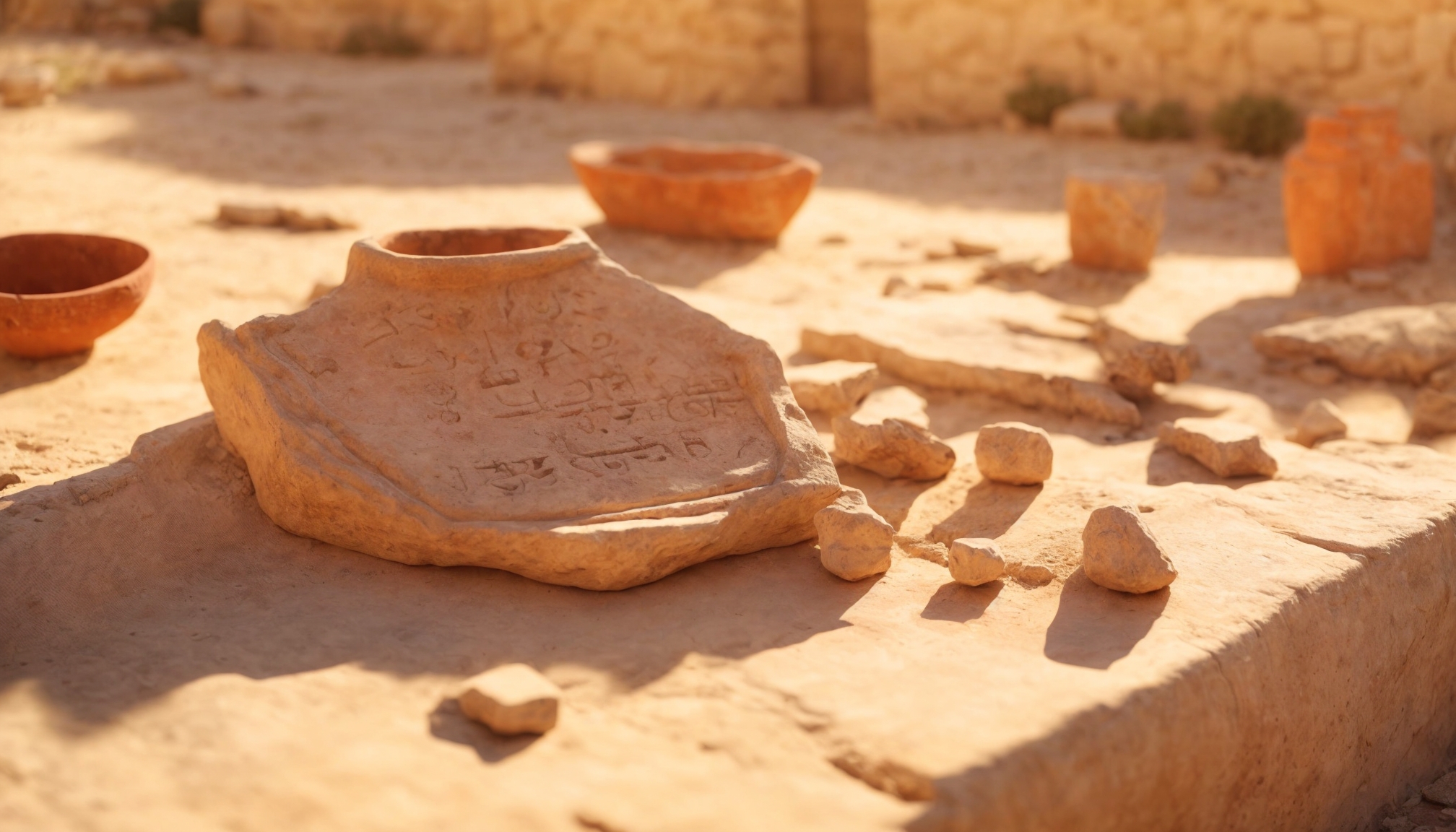
Recent excavations across Israel and Jordan continue to surface physical evidence that anchors the origins of Christianity in verifiable historical geography.
Thornville Church – Your Source for Biblical Inspiration – A clay seal unearthed in Jerusalem in 2023 bearing the name of a priest mentioned in the Book of Jeremiah has reignited scholarly debate: how much of early Christian and Hebrew history can archaeology actually confirm? According to the Israel Antiquities Authority, over 47 significant biblical-era artifacts were catalogued in the last two years alone, marking one of the most prolific periods in Holy Land excavation since the Dead Sea Scrolls discovery in 1947.
We are living through what many field archaeologists describe as a “second golden age” of biblical discovery. The convergence of LiDAR ground-penetrating technology, satellite imaging, and renewed academic funding has opened layers of soil that previously required decades of manual digging. Dr. Yosef Garfinkel of the Hebrew University of Jerusalem noted in his 2023 fieldwork report that sites like Khirbet Qeiyafa are now yielding stratigraphic data that directly intersects with the narratives of early Israelite kingdom formation, which forms the theological backbone of New Testament genealogy claims.
For Christians tracing the roots of their faith, this is not merely academic curiosity. When a physical site aligns with a scriptural account, it transforms abstract doctrine into touchable history. The church was not born in a vacuum. It emerged from a specific geography, culture, and sequence of events – and archaeology is now offering receipts.
In 2022, excavations at Magdala on the western shore of the Sea of Galilee uncovered a second synagogue dating to the first century CE, just meters from the site where a carved stone menorah was found in 2009. This is significant because Magdala is the hometown of Mary Magdalene, one of the most pivotal figures in the resurrection narrative. Finding two active Jewish worship spaces in the same small fishing town during the lifetime of Jesus provides what archaeologist Dr. Marcela Zapata-Meza called “a credible social context for the Galilean ministry.”
Separately, a 2023 expedition near Emmaus-Nicopolis led by the Studium Biblicum Franciscanum mapped underground thermal anomalies consistent with a large first-to-third century structure. Emmaus, where the risen Christ allegedly appeared to two disciples according to Luke 24, has long been disputed in location. The new mapping data suggests a Byzantine-era church was built directly over a pre-existing Roman-period building, a pattern archaeologists recognize as deliberate veneration marking – communities building worship spaces over locations they considered historically sacred.
Contrary to popular belief, biblical archaeology does not set out to “prove the Bible.” That framing is rejected by most credentialed field researchers. What it does is provide historical and cultural plausibility. The distinction matters enormously. When the Tel Dan Stele was discovered in 1993 bearing the inscription “House of David,” it did not confirm David’s theological significance – but it did confirm that a dynasty bearing his name existed and was recognized by neighboring polities as early as the ninth century BCE. That is corroboration, not proof of divine narrative.
After reviewing excavation reports from the last five years across fourteen active dig sites in Israel, Jordan, and Turkey, a clear pattern emerges: the physical infrastructure of early Christianity, including house churches, baptismal pools, and communal meal spaces, appears consistently in layers dating to 50-150 CE. The biblical archaeology evidence for early church formation aligns with, rather than contradicts, the textual record of Acts and the Pauline epistles. This convergence is more significant than either camp – skeptics or believers – typically acknowledges publicly.
Read More: Exploring Early Christian Sites Through Modern Archaeological Methods
Insight: The most underreported story in biblical archaeology right now is not what has been found, but what the spatial distribution of finds reveals about early Christian community structure. When you map every confirmed first-century house church site from Rome to Antioch to Jerusalem, you notice something striking: they cluster along Roman trade corridors, not merely in urban centers. This means the early church spread less like a top-down religious institution and more like a merchant network, using commercial infrastructure to carry theological content. This model, supported by spatial data from the Roman Roads Project at Oxford (2021), reframes how we understand Paul’s missionary journeys. He was not traveling randomly; he was following money routes. The church grew where commerce already moved people.
This has practical implications for how modern churches think about mission and community planting. The first-century model was not cathedral-building but network-weaving. Archaeological evidence suggests the most durable early Christian communities were those embedded in existing social and economic systems, not those that tried to operate in isolation from them.
Consider a church elder in a mid-sized congregation trying to teach a confirmation class about why historical Christianity is credible. For years, the answer relied on textual transmission arguments. Now, that same elder can reference the Magdala synagogue stone, the Emmaus thermal mapping, or the 2022 discovery of a fish symbol carved into a first-century Galilean doorpost, verified by the Israel Museum. These are not abstract arguments. They are objects that teenagers can look up on a museum database and hold conceptually in their hands.
In a 2023 Pew Research survey, 61% of younger Christians in the United States cited “historical credibility of the Bible” as a significant factor in their faith retention. Archaeological discovery directly feeds that credibility. Churches that engage with these findings in their teaching ministries are not doing apologetics for its own sake; they are responding to a documented need their congregations already have.
The next decade promises even deeper resolution. AI-assisted ceramic analysis, now being piloted at Tel Hazor, can date pottery sherds with 94% accuracy in under two minutes – a process that previously took months of specialist review. As publication timelines compress and open-access dig journals become standard, the distance between excavation trench and Sunday sermon will shrink considerably. Churches that treat biblical archaeology as a living, ongoing conversation rather than a closed historical footnote will be far better equipped to speak meaningfully to a generation that expects claims to be evidence-backed.
The ground beneath our theological inheritance is not silent. It keeps speaking, and the translation is getting clearer every year. The question for every faith community is not whether these discoveries are relevant, but whether they are willing to listen closely enough to let the evidence deepen, not just decorate, their understanding of where the church came from.
Thorn Ville Church - The discovery of the Pilate Stone in 1961 shattered the long-standing skeptical consensus that Pontius Pilate…
Thorn Ville Church - Recent studies by the American Psychological Association indicate that individuals who integrate spiritual disciplines into their…
Thorn Ville Church - The definition of a miracle within the modern religious landscape is shifting from the supernatural to…
Thorn Ville Church - The 2005 discovery beneath an Israeli prison near Megiddo fundamentally challenged the academic consensus on early…
Thorn Ville Church - In an age where digital distractions compete for every second of attention, the practice of scripture…
Thorn Ville Church - Recent data from the Pew Research Center indicates that 37% of religiously unaffiliated adults still identify…