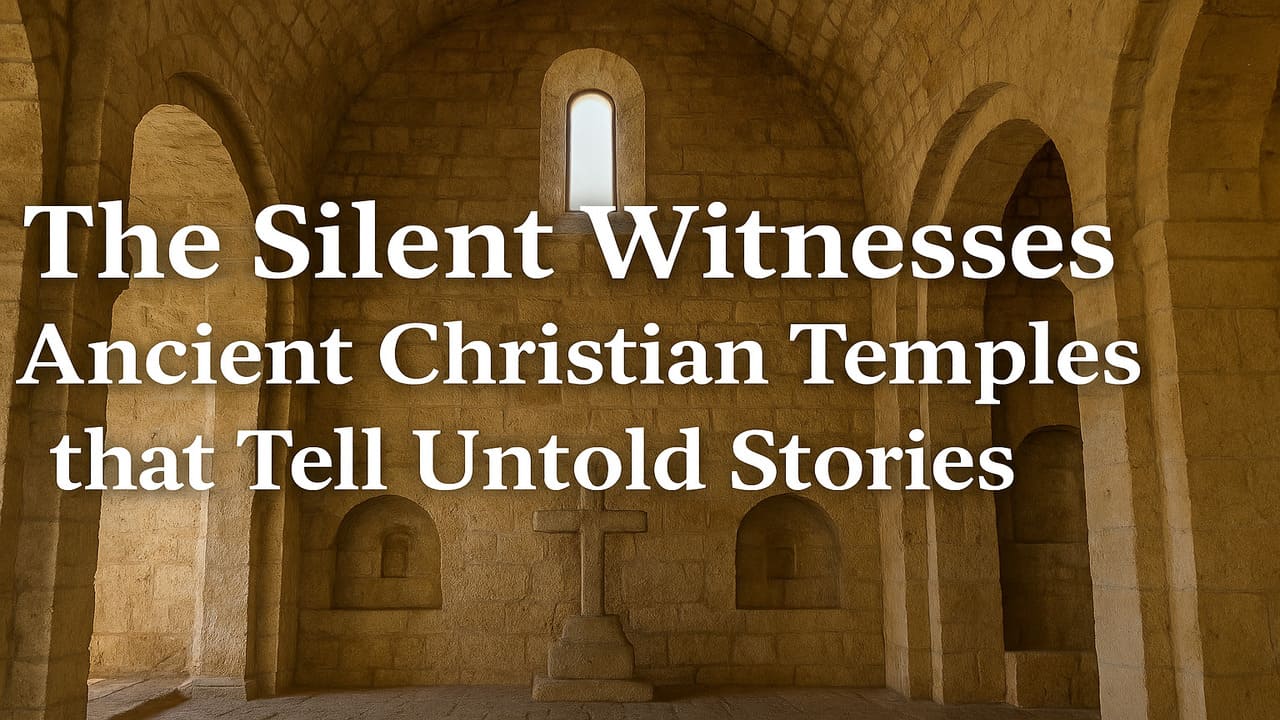
Thorn Ville Church – Scattered across landscapes from the Middle East to the heart of Europe, Ancient Christian Temples stand as solemn guardians of a spiritual legacy that spans nearly two millennia. While modern churches bustle with worship and ceremony, these early sanctuaries often weathered, isolated, or forgotten whisper stories of devotion, resilience, and cultural transformation.
These sacred sites, carved into hillsides, built atop Roman ruins, or hidden beneath modern cities, are more than just architectural remnants. They are silent witnesses to the earliest expressions of Christian faith testaments to an era when believers practiced in secrecy, communities gathered in caves, and martyrs were honored in hidden shrines.
To walk through one of these ancient temples is to step into the world of early Christianity a world shaped by persecution, survival, and eventually, triumph.
Many of the earliest Christian temples were never meant to impress with grandeur. In the 1st to 3rd centuries AD, Christianity was still illegal within the Roman Empire. Early Christians often worshiped in catacombs, private homes (known as house churches), and remote caves.
One remarkable example is the Catacombs of San Callisto in Rome. Though seemingly no more than a burial ground, these underground labyrinths became the earliest sanctuaries for Christian rites and memorials. Walls were etch with fish symbols, the Chi-Rho, and biblical scenes coded visuals for a faith under threat.
In Cappadocia, Turkey, entire subterranean communities were formed, complete with chapels carved into rock, frescoed walls, and baptismal chambers. These cave churches not only provided shelter from Roman authorities but were also physical expressions of the spiritual journey inward literally seeking God in hidden places.
Read More : Blackpink World Tour Comeback Schedule 2025, will Start in July
Following the Edict of Milan in 313 AD, Christianity emerged from the shadows and became the state religion of the Roman Empire. With this dramatic shift came the construction of monumental churches and temples, many of which still stand today.
The Church of the Nativity in Bethlehem, originally built in the 4th century by Emperor Constantine, is believe to stand over the very cave where Jesus was born. Though damaged and rebuilt over centuries, its original columns and mosaics still survive bearing silent witness to 1,700 years of continuous worship.
In Syria, the Church of Saint Simeon Stylites (5th century) was once among the largest and most famous churches in the Byzantine world, built to honor a hermit saint who lived atop a pillar for decades. Now in ruins, the arches and cross-shaped layout still stir awe, reminding us of the zeal that built it.
While the walls of ancient temples rarely speak, their artwork does. From intricate mosaics and frescoes to cryptic symbols etched in stone, early Christian artists embedded theology, history, and emotion into their sacred spaces.
At Dura-Europos in Syria, archaeologists discover what may be the oldest known Christian house church, with wall paintings dating to the mid-3rd century. These images, including a depiction of Jesus healing the paralytic, offer rare visual insight into Christian belief before institutionalization.
Meanwhile, in Italy’s Ravenna, 5th- and 6th-century basilicas such as San Vitale and Sant’Apollinare Nuovo showcase glorious mosaics of Christ, apostles, and Old Testament scenes early efforts to tell biblical stories visually to largely illiterate congregations.
In these ancient temples, art was not decoration it was devotion, instruction, and resistance.
Read More : Time-Tested Temples: Ancient Christian Churches Still Standing Today
Some ancient Christian temples vanished beneath the sands of time literally. Buried by shifting landscapes, covered by newer construction, or lost to political upheaval, many sites remained hidden for centuries.
In Egypt, the discovery of ancient Christian monastic complexes in the Western Desert revealed how anchorites and monks formed entire religious cities in the early centuries. These ruins, now undergoing excavation, provide new insights into ascetic life and liturgical evolution.
In Ethiopia, the famed Lalibela churches, carved directly into red volcanic rock, have stunned archaeologists for decades. Built in the 12th–13th centuries, these monolithic structures mimic earlier Christian temple designs and are still in active use today.
Their preservation, often in remote or difficult-to-access locations, is a testament to the spiritual value placed upon them by the communities that protected them.
Today, many ancient Christian temples are UNESCO World Heritage Sites, attracting scholars, tourists, and pilgrims alike. However, with age comes vulnerability. Erosion, conflict, and neglect pose growing threats to these irreplaceable sites.
Modern pilgrims and travelers play a critical role not just in visiting these sites, but in preserving them. Responsible tourism, financial support for conservation efforts, and spreading awareness help ensure that these silent witnesses continue to speak to future generations.
For spiritual seekers, historians, and the simply curious, exploring these ancient churches is a rare opportunity to touch a living history of faith etched in stone, layered in paint, and wrapped in silence.
Thornville Church - Your Source for Biblical Inspiration - ancient church history exploration unfolds a journey into some of the…
Thornville Church - Your Source for Biblical Inspiration – Recent discoveries in biblical archaeology church narratives have shed new light…
Thornville Church - Your Source for Biblical Inspiration - A remarkable event unfolded during a night in Philippi prison, where…
Thornville Church - Your Source for Biblical Inspiration - early churches influenced worship practices that have shaped Christian traditions throughout…
Thornville Church - Your Source for Biblical Inspiration - Ancient christian sites inspire faith by serving as profound reminders of…
Thornville Church - Your Source for Biblical Inspiration - numerous hidden christian heritage sites worth discovering remain off the beaten…