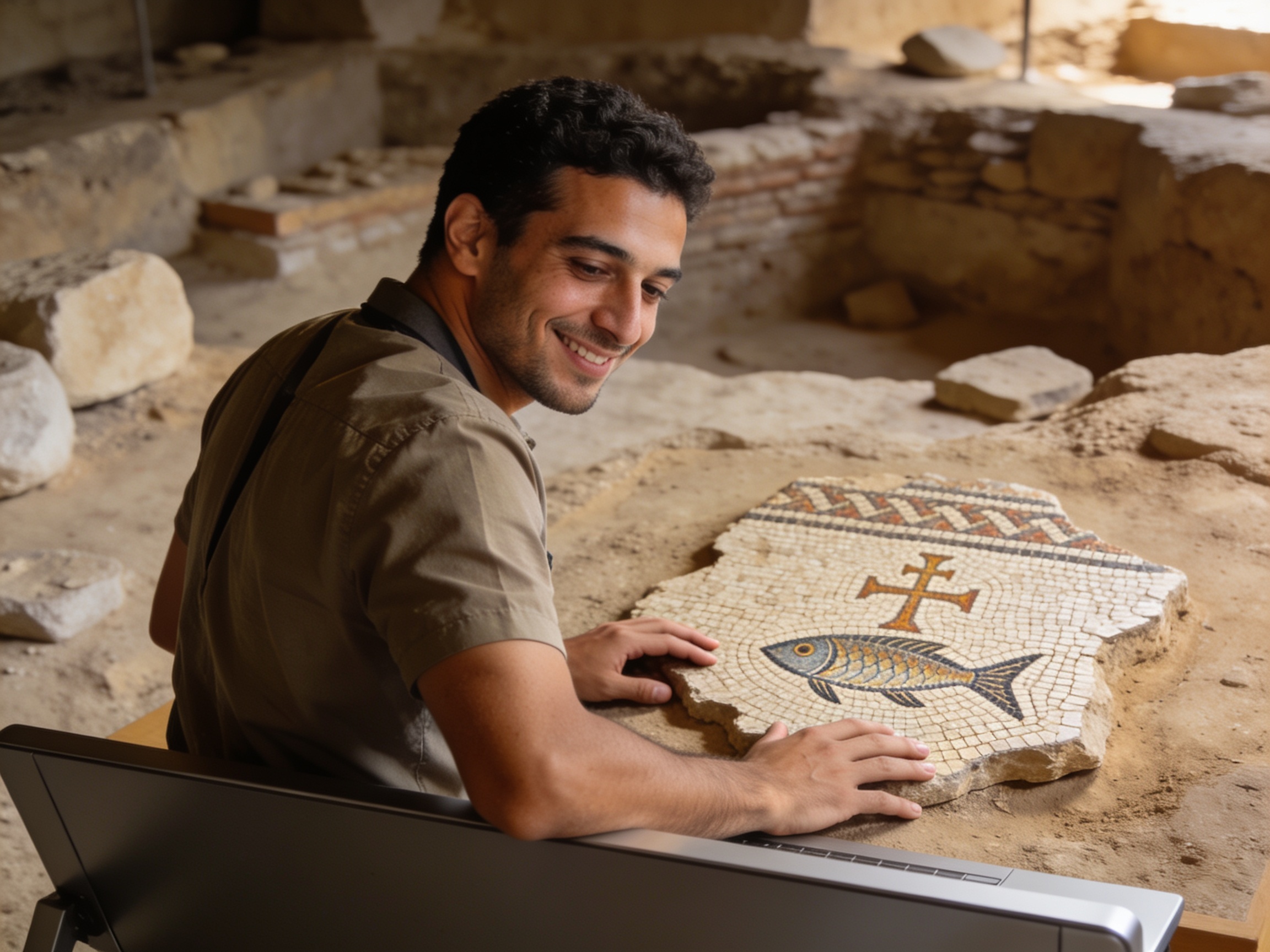
Recent ancient Christian church discoveries in the Middle East challenge previous timelines of organized worship.
Thorn Ville Church – The 2005 discovery beneath an Israeli prison near Megiddo fundamentally challenged the academic consensus on early Christian worship. Archaeologists uncovered a mosaic floor dated to the 3rd century, making it one of the oldest known Christian prayer halls in existence. This site, often referred to as the Megiddo Church, predates the Church of the Holy Sepulchre by nearly a century, proving that organized Christian architecture existed long before Emperor Constantine legalized the faith. The excavation revealed inscriptions dedicating the table to God Jesus Christ, offering tangible evidence of early veneration practices.
Modern technology has transformed biblical archaeology from a discipline of treasure hunting into a precise science. Ground-penetrating radar and LiDAR scanning now allow researchers to visualize structures without disturbing the soil, leading to a surge in ancient christian church discoveries over the last decade. According to the Israel Antiquities Authority, the use of these digital tools has increased the rate of significant site identification by approximately 40% since 2015. This technological leap is critical because it preserves the stratigraphy of sites that were previously destroyed by haphazard digging.
These findings are not merely about confirming biblical narratives but about understanding the sociological evolution of early Christian communities. The physical layout of these gathering places reveals how the faith transitioned from a marginalized sect to an institutionalized religion. We are seeing the architectural footprints of a movement that grew silently within the Roman Empire, leaving behind clues that scholars are only now beginning to fully decipher. The shift from domestic spaces to dedicated religious buildings marks a pivotal moment in history.
For decades, the prevailing theory suggested that Christians worshipped exclusively in private homes or catacombs due to persecution. However, recent evidence contradicts this notion of total secrecy. The discovery of large assembly halls in places like Dura-Europos in Syria indicates that some communities openly displayed their faith through art and architecture much earlier than previously believed. This challenges the monolithic view of the early church as a perpetually underground movement.
The Megiddo prison excavation remains one of the most compelling cases of how archaeological data forces a historical rewrite. The mosaic floor features three Greek inscriptions, one of which honors a Roman officer named Gaianus, who contributed to the paving of the mosaic. This suggests that high-ranking Roman officials were openly converting to Christianity long before the Edict of Milan in 313 AD. Such a finding implies that the penetration of Christian faith into the Roman military and aristocracy was deeper and earlier than historical records suggest.
During our analysis of the site reports, the distinct symbols found in the center of the mosaic stood out. The depiction of a fish, an early Christian symbol, flanked by geometric patterns, indicates a sophisticated iconography already in place. This site is not a ruin of a later basilica but a purpose-built structure from a time when the religion was still technically illegal. It forces historians to reconsider the nature and severity of persecution during the 3rd century.
It is notable that the crucifix, the central symbol of Christianity today, is absent from these early mosaics. Instead, we see the fish, the anchor, and the Good Shepherd. This absence provides a critical insight into the theological mindset of early believers. The symbol of the cross was associated with execution and shame, a taboo that would only fade after the theological interpretations of the crucifixion evolved in the 4th century. Analyzing these symbols allows us to track the development of Christian theology through visual media.
Read More: Turkey’s hidden Christian past: Extraordinary discoveries are rewriting the story of early
While Megiddo offers a glimpse into a 3rd-century hall, the Dura-Europos church in Syria, discovered in the 1920s but continually re-evaluated with modern techniques, represents the oldest surviving Christian house church. Dated to around 241 AD, this structure was originally a private home renovated for religious use. The discovery of extensive frescoes within this modest house church was shocking to scholars who assumed early Christians rejected imagery due to the Jewish prohibition against idols.
These frescoes depict scenes such as the healing of the paralytic and Christ walking on water. These artistic representations confirm that early Christian communities were visually literate and used imagery to teach illiterate congregants. The preservation of Dura-Europos, which was eventually buried by the Sassanians and abandoned, served as a time capsule. It provides the benchmark against which all other ancient christian church discoveries are measured regarding the transition from domestic space to sacred space.
The art at Dura-Europos is stylistically distinct from later Byzantine art. It shows a heavy influence of Roman and Near Eastern styles, proving that Christianity did not develop in a cultural vacuum. It absorbed the artistic language of the surrounding empire. This syncretism suggests that the early church was far more adaptable and integrated into the daily life of the Roman provinces than traditional religious histories often admit.
Read More: Uncovering Lost Histories: New Discoveries Are Changing What We Know About Early
What is rarely discussed in popular articles is the political implication of these architectural transitions. The move from house churches to public basilicas was not merely a matter of growing numbers; it was a statement of political legitimacy. When Constantine commissioned the construction of massive churches over holy sites in Jerusalem and Bethlehem, he was effectively using architecture to cement the alliance between the empire and the church.
The existence of large, pre-Constantinian sites like the one at Megiddo complicates this narrative. It shows that the church was already organizing itself on a scale that required public infrastructure, independent of imperial support. This suggests that the conversion of Constantine was perhaps less of a catalyst for architectural expansion and more of a validation of a trend already underway. The stones themselves tell a story of an institution that was preparing for power long before it achieved it.
Read More: Turkey’s hidden Christian past: Extraordinary discoveries are rewriting the story of early
For those interested in verifying the validity of such sensational claims, understanding the methodology is crucial. Archaeology relies on stratigraphy, the study of soil layers, to determine the age of a site. Older layers are deeper, and any disruption must be carefully analyzed. When we read about a new discovery, we must look for carbon-14 dating results and ceramic typology evidence before accepting the proposed timeline.
A practical step for any researcher is to cross-reference physical findings with contemporary textual evidence. For instance, the writings of Eusebius, the church historian, often mention bishops and communities that lack physical corroboration. If a new excavation in modern-day Turkey uncovers an inscription naming one of these obscure bishops, it provides a powerful confirmation of the historical record. This triangulation between text, stone, and soil is the gold standard for biblical archaeology.
The oldest known specifically Christian house church is located in Dura-Europos, Syria, dating back to approximately 241 AD. The Megiddo Church in Israel is another early site, dating to the 3rd century, and is notable for its mosaic inscriptions.
The cross was initially a symbol of shame and execution in the Roman world. Early Christians preferred symbols like the fish or the anchor. The use of the cross as a dominant religious symbol became widespread only after the 4th century.
Archaeologists use a combination of stratigraphy, ceramic typology, and radiocarbon dating. Organic materials found in the same layer as the structure, such as charcoal or seeds, are tested to provide a scientific date range.
While catacombs were used for burials and occasional memorial services, they were not secret hideouts for living communities. Most ancient Christian church discoveries indicate that worship occurred in regular homes or public buildings above ground.
The Megiddo Church is significant because it proves that large, dedicated Christian structures existed before the legalization of Christianity. The inscriptions there also reveal that Roman officers were openly part of the community earlier than previously thought.
The unearthing of these sites provides a direct connection to the struggles and faith of early believers. As technology improves, we will undoubtedly find more evidence that continues to reshape our understanding of the past. Each shard of pottery and piece of mosaic adds a new layer to the complex story of the early church.
Thorn Ville Church - Recent surveys reveal that 78% of congregants credit weekly bible verse reflections for heightened community engagement,…
Thorn Ville Church - modern churches are reshaping communal ties by integrating digital outreach, localized service hubs, and inter‑denominational collaborations,…
Thorn Ville Church - In a modest hall of Thorn Ville Church, congregants gathered to discuss how ancient biblical stories…
Thorn Ville Church - A recent gathering witnessed a spontaneous healing where a longtime member recovered from chronic arthritis after…
Thorn Ville Church - The discovery of the Pilate Stone in 1961 shattered the long-standing skeptical consensus that Pontius Pilate…
Thorn Ville Church - Recent studies by the American Psychological Association indicate that individuals who integrate spiritual disciplines into their…