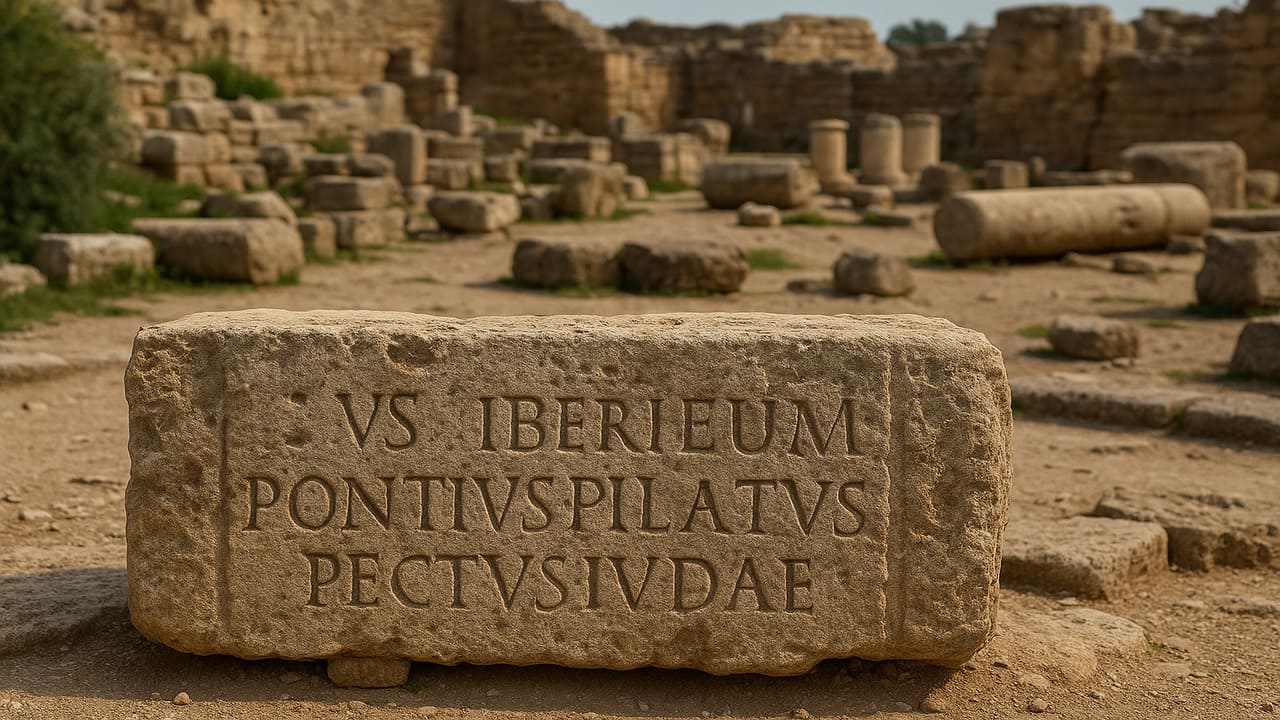
Thorn Ville Church – Among the many archaeological discoveries that have helped illuminate the historical accuracy of the Bible, few are as striking and direct as the Pilate Stone. Unearthed in 1961 in the ancient port city of Caesarea Maritima, this limestone block bears an inscription that mentions Pontius Pilate, the Roman governor of Judea who famously presided over the trial of Jesus Christ. For centuries, Pilate was known almost exclusively through biblical and historical texts. But with the discovery of this single stone, his existence moved from faith to fact etched permanently into history.
Pontius Pilate served as the fifth prefect of the Roman province of Judea, under Emperor Tiberius, from roughly AD 26 to AD 36. His name appears in all four Gospels, primarily as the official who authorized the crucifixion of Jesus. He is portrayed as a conflicted figure pressured by religious leaders and wary of unrest among the people ultimately washing his hands of the matter and leaving the decision to the crowd.
Outside of Scripture, Pilate’s name also appears in the writings of Josephus, a first-century Jewish historian, and Tacitus, a Roman senator and historian. But until the 20th century, no physical artifact bearing his name had been found, leaving some scholars to question the historical accuracy of his role. That changed in a single moment of archaeological clarity.
Also Read : Walking Yoga: The Fusion of Movement, Breath, and Mindfulness
In 1961, Italian archaeologists excavating a Roman theater in Caesarea Maritima, a coastal city built by Herod the Great, discovered a damaged block of limestone reused in a later construction. When pieced together and translated, the Latin inscription on the stone read:
“[To] the Divine Augustus Tiberieum … Pontius Pilate … Prefect of Judea … has dedicated [this].”
This was the first archaeological evidence directly naming Pilate, identifying him as the prefect (governor) of Judea and confirming his administrative authority during the early first century. The discovery was a groundbreaking moment for biblical archaeology, not only confirming Pilate’s existence but also tying him to Roman imperial worship likely the context of the dedication.
The Pilate Stone doesn’t just verify a person; it provides historical context. The inscription shows that Pilate, like other Roman officials of his time, engaged in acts of loyalty and dedication to the emperor, in this case Tiberius Caesar. The reference to “Tiberieum” suggests that Pilate may have built or restored a temple or public structure in the emperor’s honor perhaps to gain favor or fulfill Roman expectations of political allegiance.
This image of Pilate as a devout Roman administrator adds dimension to the biblical portrayal. It hints that his decisions, including those during Jesus’ trial, may have been shape not just by local politics but by loyalty to Rome and concern for order.
Also Read : The Galilee Boat: A 1st Century Vessel from the Time of Jesus
The Pilate Stone is not a religious artifact per se it doesn’t mention Jesus or Christianity. But its value to biblical history is undeniable. It serves as tangible proof of a New Testament figure, reinforcing the accuracy of Gospel narratives and anchoring them in the real world of first-century Roman politics and governance.
In an era where some critics dismiss parts of the Bible as legend or literary symbolism, archaeological finds like this one offer solid ground. They confirm that many biblical characters weren’t just symbolic they were real, historical people who made real decisions with lasting consequences.
For historians, archaeologists, and believers alike, the Pilate Stone is more than just carved rock. It’s a bridge between faith and fact, between the spiritual truths of Scripture and the physical record of history. It also exemplifies how archaeology continues to enhance biblical understanding not to replace faith, but to enrich it.
Displayed today in the Israel Museum in Jerusalem (with a replica in Caesarea), the Pilate Stone invites every visitor to see the Gospel accounts not as distant legends but as events grounded in time and place.
Whether you’re a seeker of truth, a student of history, or a person of faith, the stone speaks across centuries with a silent message: the people of the Bible walked among us, and the stories we read are part of the world’s enduring heritage.
Thorn Ville Church - A recent gathering witnessed a spontaneous healing where a longtime member recovered from chronic arthritis after…
Thorn Ville Church - The discovery of the Pilate Stone in 1961 shattered the long-standing skeptical consensus that Pontius Pilate…
Thorn Ville Church - Recent studies by the American Psychological Association indicate that individuals who integrate spiritual disciplines into their…
Thorn Ville Church - The definition of a miracle within the modern religious landscape is shifting from the supernatural to…
Thorn Ville Church - The 2005 discovery beneath an Israeli prison near Megiddo fundamentally challenged the academic consensus on early…
Thorn Ville Church - In an age where digital distractions compete for every second of attention, the practice of scripture…