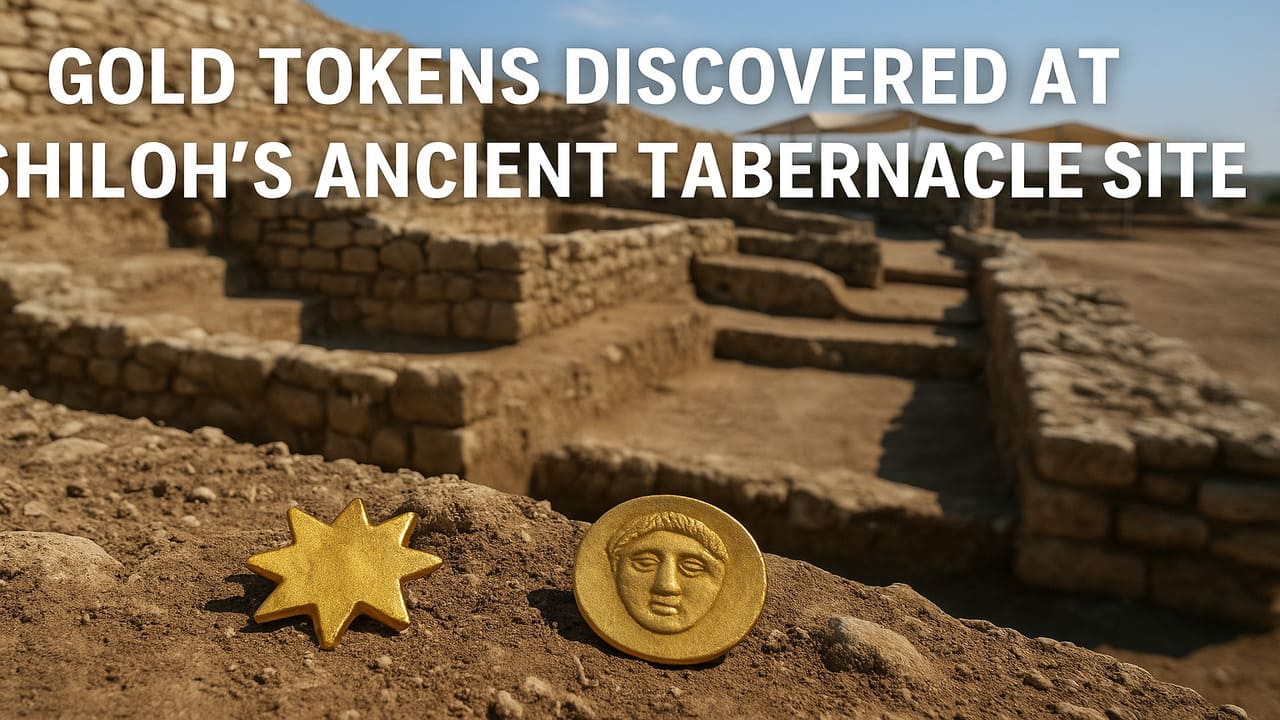
Thorn Ville Church – The archaeological site of Shiloh in Israel has long fascinated historians, archaeologists, and biblical scholars. Known as the place where the Israelite tabernacle stood for centuries, Shiloh is a cornerstone of biblical history and a focal point for discoveries like Tabernacle Gold that shed light on ancient worship practices. Over the years, excavations at Shiloh have revealed pottery, sacrificial remains, and structures that align with the biblical account of a sacred center of worship.
Recently, another extraordinary find has captured the attention of researchers and faith communities alike. In an area identified as a favissa a sacrificial burial pit used to store religious offerings excavators unearthed small but highly significant gold artifacts. These discoveries are date to the time when the tabernacle was still standing, adding weight to their cultural and religious importance.
Among the artifacts retrieve from the favissa were small star-shaped gold tokens. These delicate items, though modest in size, point to a tradition of presenting valuable objects as offerings to God. The use of gold, a material often associated with divinity, purity, and eternal value, underscores the significance of these tokens in the context of ancient Israelite worship.
One particular find stands out from the rest a gold piece engraved with a human face. This striking object immediately invites speculation. Was it meant to symbolize a worshipper, a deity, or perhaps an abstract representation of devotion? While definitive answers remain elusive until further research is publish, the artifact provides a rare glimpse into the artistic and symbolic expressions of Israel’s early faith practices.
The discovery at Shiloh is credited to Dr. Scott Stripling and the Associates for Biblical Research (ABR), a team dedicated to uncovering evidence of the biblical world. Dr. Stripling’s excavations have been at the forefront of significant finds in Israel, and his methodical approach continues to bring ancient narratives into clearer focus.
In interviews conducted earlier this year, Dr. Stripling confirmed that the Shiloh team is still analyzing the gold items, with plans to release detailed reports and photographs. For now, much of the information remains within professional circles and the ABR channel, but anticipation is growing for the eventual publication. This controll release ensures that the artifacts are studied carefully before broader conclusions are drawn.
The Tabernacle Gold at Shiloh is not just a matter of archaeological curiosity—it is a find that bridges history, faith, and identity. First, it provides tangible evidence that supports biblical references to Shiloh as a site of central worship. The gold offerings suggest rituals that involved personal sacrifice and devotion, confirming that the community treated the tabernacle as a sacred center.
Second, the find enriches our understanding of material culture in ancient Israel. While much attention has been give to pottery and architecture, the presence of fine gold offerings demonstrates that religious life also included symbolic tokens of great value. Such discoveries help contextualize the wealth, craftsmanship, and priorities of the people who lived in the region during that time.
These questions highlight the importance of continued excavation and scholarship. Each artifact invites interpretation, and in doing so, brings new dimensions to our comprehension of biblical-era worship practices.
Read More : Israel’s Rampage Sparks Outrage: Erdogan Labels Netanyahu a Modern-Day Hitler!
Instead of serving as a conclusion, this discovery opens the door to future possibilities. The Tabernacle Gold at Shiloh is likely to inspire fresh archaeological efforts not only at this site but also at other locations tied to biblical worship. Scholars anticipate that once detailed publications are release, the gold tokens may appear on numerous “Top 10 Discoveries of 2025” lists, further cementing Shiloh’s importance on the global stage.
Beyond academic circles, the discovery has the power to enhance Shiloh’s role as a destination for faith-based tourism. Pilgrims and visitors who come to see the site of the ancient tabernacle may soon be able to connect more directly with artifacts that illustrate the devotion of Israel’s earliest worshippers. The anticipation surrounding these finds signals that Shiloh will remain a central point of interest for both scholars and the public in years to come.
This Article About Tabernacle Gold Written by: Sarah Azhari | Editor: Micheal Halim
Information Source: armstronginstitute.org
Thorn Ville Church - The discovery of the Pilate Stone in 1961 shattered the long-standing skeptical consensus that Pontius Pilate…
Thorn Ville Church - Recent studies by the American Psychological Association indicate that individuals who integrate spiritual disciplines into their…
Thorn Ville Church - The definition of a miracle within the modern religious landscape is shifting from the supernatural to…
Thorn Ville Church - The 2005 discovery beneath an Israeli prison near Megiddo fundamentally challenged the academic consensus on early…
Thorn Ville Church - In an age where digital distractions compete for every second of attention, the practice of scripture…
Thorn Ville Church - Recent data from the Pew Research Center indicates that 37% of religiously unaffiliated adults still identify…